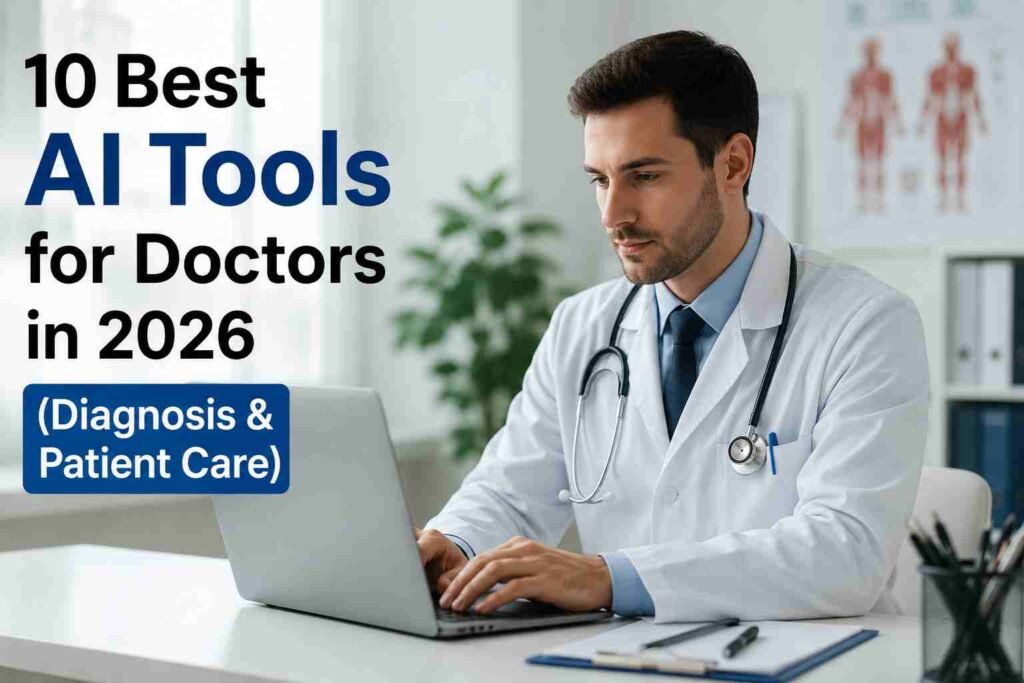
Artificial Intelligence is slowly changing the way doctors work in hospitals and clinics. In 2026, AI tools for doctors are no longer something experimental—they are becoming a normal part of everyday medical practice.
Doctors today deal with huge pressure: long working hours, too many patients, and a lot of paperwork. This is where AI in healthcare is making a real difference. These tools help doctors understand symptoms faster, read medical scans more accurately, and manage patient records without wasting time on manual work. From simple symptom checkers to advanced diagnostic systems, medical AI tools are designed to support doctors, not replace them. They act like a smart assistant that helps in decision-making and improves patient care.
In this article, we will look at the 10 best AI tools for doctors in 2026 that are actually being used in real healthcare environments. You will see how each tool works, what it does best, and how it is helping doctors save time and improve accuracy in daily practice.
Quick Answer
👉 Viz.ai is the best AI tool for doctors (especially for emergency care and stroke detection) because it provides real-time alerts and helps in faster clinical decision-making in hospitals.
Related: Here are 10 Best AI Tools for Teachers in 2026 (Top Platforms Compared)
What Are AI Tools for Doctors?

AI tools for doctors are software systems that use machine learning, deep learning, and data analysis to assist in medical tasks.
They support doctors in:
- Reading medical scans (X-ray, MRI, CT scan)
- Writing clinical notes
- Suggesting possible diagnoses
- Monitoring patient health
- Managing hospital workflows
These tools do not replace doctors—they support and enhance medical decisions.
Why Doctors Need AI Tools in 2026
The healthcare system is overloaded with patients and data. AI helps solve this problem.
Key Benefits:
- Faster diagnosis
- Data-driven decision making
- Automated documentation
- Better clinical accuracy
- Time-saving in hospitals
- Improved patient care
This is why AI in healthcare is one of the fastest-growing technologies globally.
AI Tools for Doctors – Full Comparison (2026)
| # | Tool | Category | Main Use | Best For | Rating |
|---|---|---|---|---|---|
| 1 | Ada Health | Symptom Checker | Early symptom analysis | Patients & Triage | ⭐ 4.4/5 |
| 2 | IBM Watson Health | Clinical AI | Decision support & data analysis | Hospitals & Research | ⭐ 4.3/5 |
| 3 | Aidoc | Medical Imaging AI | CT / MRI analysis | Radiology | ⭐ 4.5/5 |
| 4 | Viz.ai | Emergency AI | Stroke detection & alerts | Emergency Care | ⭐ 4.7/5 |
| 5 | Suki AI | Voice AI | Clinical documentation | Doctors & Clinics | ⭐ 4.5/5 |
| 6 | Abridge AI | Medical Notes AI | Conversation to notes | Clinical documentation | ⭐ 4.6/5 |
| 7 | PathAI | Pathology AI | Cancer & tissue analysis | Labs & Research | ⭐ 4.5/5 |
| 8 | Google DeepMind Health | Research AI | Disease prediction | Hospitals & Research | ⭐ 4.6/5 |
| 9 | Tempus AI | Precision Medicine | Genomic analysis | Cancer care | ⭐ 4.6/5 |
| 10 | Butterfly iQ | AI Ultrasound | Portable imaging | Emergency care | ⭐ 4.6/5 |
1. Ada Health (AI Medical Symptom Checker)
Ada Health is a widely used AI in healthcare tool that works as a smart symptom checker. It helps patients understand possible health conditions based on their symptoms and guides them toward the next step of care.
It is also used as a clinical support tool by doctors for early patient assessment and triage. However, it is not a replacement for professional medical diagnosis.
🔗 Official Website: https://ada.com
Key Features
- AI-powered symptom checker for patients and doctors
- Step-by-step medical questioning system
- Provides possible condition suggestions based on symptoms
- Multi-language support for global users
- Generates structured health reports
- Useful for initial patient triage
How Ada Health Works
- User enters symptoms into the app
- AI asks follow-up health questions
- System analyzes symptoms using medical knowledge base
- It suggests possible conditions
- It recommends whether to see a doctor or not
Clinical Safety
Ada Health is a clinical decision support tool, not a diagnostic system. It is designed to assist patients and doctors in early assessment only. Final diagnosis and treatment decisions must always be made by qualified healthcare professionals to ensure patient safety.
Pros
✔ Easy to use for both patients and doctors
✔ Fast symptom analysis within minutes
✔ Helps in early detection and triage
✔ Strong medical knowledge base
✔ Improves patient awareness and understanding
Cons
✖ Not a replacement for medical diagnosis
✖ Limited accuracy in complex or rare diseases
✖ Can sometimes cause unnecessary anxiety
✖ Requires internet connection
Pricing
Ada Health is mostly free for individual users.
Free Plan includes
- Symptom checker
- Health insights
- Basic AI recommendations
Enterprise Plan (for hospitals and clinics)
- Custom pricing based on usage
- Advanced clinical integration
- Healthcare system solutions
Contact: https://ada.com/contact/
Rating
Overall Rating ⭐ 4.4/5
Related: Here are 7 Best AI Image Generators (Tested & Reviewed – 2026)
2. IBM Watson Health (Now Merative Health)
IBM Watson Health, now known as Merative Health, is a powerful AI in healthcare platform designed to support doctors, hospitals, and researchers in making better clinical decisions. It uses artificial intelligence and big data to analyze large volumes of medical information and generate useful insights for AI Tools for Doctors.
It is widely used in hospitals for clinical decision support, patient risk prediction, and medical data analysis, especially in complex cases where large datasets are involved.
🔗 Official Website: https://www.merative.com/health
Key Features
- AI-powered clinical decision support system
- Advanced medical data analysis using machine learning
- Patient risk prediction and outcome forecasting
- Helps in treatment planning and recommendations
- Processes large-scale healthcare datasets
- Supports hospitals and research organizations
How IBM Watson Health Works
- It collects patient data from medical systems and records
- AI analyzes symptoms, reports, and clinical history
- It compares data with global medical research
- The system generates insights and treatment suggestions
- Doctors use these insights for final clinical decisions
Clinical Safety
IBM Watson Health is a clinical decision support tool, not an autonomous diagnostic system. It is designed to assist healthcare professionals, not replace them. All AI-generated insights are reviewed by qualified doctors before any treatment decisions are made, ensuring patient safety and clinical accuracy.
Pros
✔ Helps doctors analyze complex medical data quickly
✔ Supports evidence-based clinical decision-making
✔ Improves accuracy in treatment planning
✔ Useful for hospitals and large healthcare systems
✔ Enhances medical research and analytics
Cons
✖ Expensive for small clinics and individual doctors
✖ Requires technical setup and integration
✖ Not designed for direct patient use
✖ Can be complex for beginners
Pricing
IBM Watson Health (Merative) does not have fixed public pricing.
It follows a custom enterprise pricing model based on organization size, data usage, and integration requirements.
Hospitals and healthcare institutions must contact Merative directly for pricing details.
Rating
Overall Rating ⭐ 4.3/5
Related: Here are Build an Autonomous AI Sales Agent with No-Code Tools (2026 Guide)
3. Aidoc (AI Medical Imaging & Diagnosis Support Tool)
Aidoc is a leading AI in healthcare platform designed to help doctors, especially radiologists, analyze medical images such as CT scans, X-rays, and MRIs. It is widely used in hospitals to speed up diagnosis and improve patient outcomes in emergency situations.
Aidoc focuses on clinical decision support as part of AI Tools for Doctors, meaning it assists doctors by highlighting possible abnormalities in medical images, but the final medical decision always remains with healthcare professionals.
🔗 Official Website: https://www.aidoc.com
Key Features
- AI-powered analysis of medical imaging (CT, X-ray, MRI)
- Detects critical conditions like brain hemorrhage, stroke, pulmonary embolism, and fractures
- Real-time alert system for emergency cases
- Prioritization of high-risk patients in hospital workflows
- Seamless integration with PACS and hospital systems
- Supports radiologists in high-volume environments
- Continuous learning from medical data patterns
How Aidoc Works
- Medical images are uploaded from hospital systems
- AI scans images using deep learning models
- It detects abnormal findings or potential risks
- Urgent cases are flagged immediately for review
- Doctors verify results and make final clinical decisions
Clinical Safety
Aidoc is designed under strict clinical safety and regulatory standards. It functions as a decision-support tool, not an autonomous diagnostic system. It is FDA-cleared for specific use cases in medical imaging. The AI only assists by highlighting possible issues, while certified doctors are responsible for final diagnosis and treatment decisions. This ensures patient safety and reduces the risk of missed critical findings.
Pros
✔ Helps detect life-threatening conditions at an early stage
✔ Improves response time in emergency cases
✔ Reduces workload for radiologists and hospital staff
✔ Works in real-time for urgent imaging analysis
✔ Enhances accuracy in medical imaging interpretation
✔ Supports better hospital workflow and prioritization
Cons
✖ Requires hospital-level infrastructure and integration
✖ Not suitable for individual doctors or small clinics
✖ Depends heavily on high-quality imaging data
✖ Can be costly for healthcare institutions
✖ Limited use outside radiology and imaging departments
Pricing
Aidoc does not have fixed public pricing.
It follows a custom enterprise pricing model based on hospital size, number of departments, and integration needs.
Pricing typically depends on:
- Number of imaging systems connected
- Volume of scans processed
- Level of AI modules used
- Hospital or healthcare network size
For exact pricing, hospitals need to contact Aidoc directly for a custom quote.
Rating
Overall Rating ⭐ 4.5/5
4. Viz.ai (AI Stroke Detection & Care Coordination Platform)
Viz.ai is an advanced AI in healthcare platform that helps doctors quickly detect and manage life-threatening conditions like stroke. It uses artificial intelligence to analyze medical imaging and alert care teams in real time.
It is mainly used in hospitals to improve emergency response time, especially in stroke and other critical neurological conditions.
🔗 Official Website: https://www.viz.ai
Key Features
- AI-powered detection of stroke from CT scans
- Real-time alerts to medical teams
- Fast coordination between doctors, nurses, and specialists
- Integration with hospital imaging systems
- Workflow automation for emergency care
- Supports time-critical decision-making in hospitals
How Viz.ai Works
- Patient CT scans are uploaded to the system
- AI analyzes brain imaging for signs of stroke
- If a condition is detected, alerts are sent instantly
- Doctors and specialists are notified on mobile devices
- Treatment decisions are made faster through coordination
Clinical Safety
Viz.ai is designed as a clinical decision support tool, not an automated diagnostic system. It is used under hospital supervision and follows strict regulatory and safety standards.
The AI helps identify possible stroke cases quickly, but final diagnosis and treatment decisions are always made by qualified healthcare professionals. This ensures patient safety and reduces delays in emergency treatment.
Pros
✔ Detects stroke cases quickly in emergency situations
✔ Reduces treatment delay (critical for brain stroke patients)
✔ Improves coordination between medical teams
✔ Sends real-time alerts to doctors
✔ Enhances hospital workflow efficiency
✔ Helps save lives through faster response time
Cons
✖ Requires hospital-level integration
✖ Not suitable for individual doctors or small clinics
✖ Limited mainly to stroke and specific conditions
✖ Depends on high-quality imaging data
✖ Can be expensive for healthcare systems
Pricing
Viz.ai does not offer fixed public pricing.
It uses a custom enterprise pricing model based on hospital size, number of users, and system integration needs.
Hospitals must contact Viz.ai directly for pricing details.
Rating
Overall Rating ⭐ 4.7/5
Related: Here are Invoice Automation for Small Businesses in 2026 – (Beginner Guide)
5. Suki AI (Voice-Based AI Medical Assistant)
Suki AI is a modern AI in healthcare tool designed to help doctors reduce their documentation workload. It works as a voice-enabled medical assistant that converts speech into structured clinical notes.
Doctors use Suki AI mainly to save time during patient visits and reduce manual typing. It helps improve focus on patients instead of paperwork.
🔗 Official Website: https://www.suki.ai
Key Features
- Voice-to-text clinical documentation
- Automatic generation of medical notes
- Works hands-free during patient consultations
- Integration with Electronic Health Records (EHR) systems
- Reduces administrative workload for doctors
- Improves workflow efficiency in clinics and hospitals
How Suki AI Works
- Doctor speaks during patient consultation
- AI listens and understands medical conversation
- It converts speech into structured clinical notes
- Notes are automatically saved into EHR systems
- Doctor reviews and finalizes the record
Clinical Safety
Suki AI is a clinical support tool, not a diagnostic system. It does not make medical decisions. It only helps in documentation and record-keeping.
All generated notes are reviewed by doctors before final use. This ensures accuracy, compliance, and patient safety.
Pros
✔ Saves time on medical documentation
✔ Reduces doctor burnout from paperwork
✔ Improves accuracy of clinical notes
✔ Works hands-free during consultations
✔ Integrates with hospital EHR systems
✔ Improves overall productivity in healthcare
Cons
✖ Requires internet connection for full functionality
✖ May need training for best accuracy
✖ Not useful for diagnosis or treatment decisions
✖ Subscription cost may be high for small clinics
Pricing
Suki AI follows a subscription-based pricing model.
Pricing depends on:
- Number of users
- Healthcare organization size
- EHR integration requirements
Exact pricing is not publicly listed and requires contacting the company directly.
🔗 Contact: https://www.suki.ai/contact
Rating
Overall Rating ⭐ 4.5/5
6. Abridge AI (AI Medical Conversation & Documentation Tool)
Abridge AI is a powerful AI in healthcare tool that helps doctors convert patient conversations into structured medical notes. It is mainly used to reduce documentation workload and improve clinical accuracy.
Doctors use Abridge AI during patient visits to automatically record, summarize, and organize medical conversations. This helps save time and allows doctors to focus more on patient care instead of typing notes.
🔗 Official Website: https://www.abridge.com
Key Features
- AI-powered medical conversation transcription
- Automatic summarization of doctor-patient discussions
- Converts speech into structured clinical notes
- Integration with Electronic Health Records (EHR) systems
- Supports multiple medical specialties
- Helps improve documentation accuracy and efficiency
How Abridge AI Works
- Patient conversation is recorded during consultation
- AI listens and transcribes the full conversation
- It extracts key medical information
- Generates a structured clinical summary
- Doctors review and save notes in patient records
Clinical Safety
Abridge AI is a clinical documentation support tool, not a diagnostic system. It does not make medical decisions. All generated notes are reviewed by doctors before final use, ensuring patient safety and accuracy in medical records.
Pros
✔ Reduces time spent on medical documentation
✔ Improves accuracy of clinical notes
✔ Helps doctors focus more on patients
✔ Works across multiple medical specialties
✔ Integrates with EHR systems
✔ Reduces administrative workload
Cons
✖ Requires internet connection for full functionality
✖ May need review and correction by doctors
✖ Subscription cost may be high for small practices
✖ Not useful for diagnosis or treatment decisions
Pricing
Abridge AI uses a custom enterprise pricing model. Pricing depends on healthcare organization size, number of users, and integration requirements with hospital systems. Exact pricing is not publicly available and requires contacting the company.
7. PathAI (AI-Powered Pathology Diagnosis Platform)
PathAI is an advanced AI in healthcare tool that focuses on pathology and disease diagnosis. It helps doctors and pathologists analyze tissue samples more accurately using artificial intelligence.
It is widely used in labs and research centers to improve cancer detection, reduce human error, and support faster diagnosis decisions.
🔗 Official Website: https://www.pathai.com
Key Features
- AI-powered analysis of pathology slides
- Helps detect diseases like cancer at early stages
- Improves accuracy in tissue sample interpretation
- Supports medical researchers and lab technicians
- Works with digital pathology systems
- Reduces manual workload in laboratories
How PathAI Works
- Digital tissue samples are uploaded into the system
- AI analyzes pathology images using deep learning
- It identifies abnormal cells and disease patterns
- Results are highlighted for pathologists
- Doctors review and confirm final diagnosis
Clinical Safety
PathAI is a clinical decision support tool, not an automated diagnostic system. It is used under medical supervision in laboratories and research environments. Final diagnosis is always made by qualified pathologists to ensure patient safety and accuracy.
Pros
✔ Improves accuracy in disease detection
✔ Helps in early cancer diagnosis
✔ Reduces human error in pathology analysis
✔ Saves time in lab workflows
✔ Supports medical research and development
✔ Works with digital pathology systems
Cons
✖ Requires advanced lab infrastructure
✖ Not suitable for small clinics
✖ Depends on high-quality digital slides
✖ Can be expensive for healthcare institutions
✖ Limited to pathology use cases
Pricing
PathAI follows a custom enterprise pricing model. Pricing depends on lab size, usage volume, and integration requirements. Exact pricing is not publicly available and requires contacting the company directly.
🔗 Contact: https://www.pathai.com/contact
Rating
Overall Rating ⭐ 4.5/5
Related: Here are 12 Best AI Tools for Coding in 2026 (Top Picks for Developers
8. Google DeepMind Health (AI for Medical Research & Diagnosis)
Google DeepMind Health is a powerful AI in healthcare initiative developed by Google DeepMind. It focuses on using artificial intelligence to solve complex medical problems and support doctors in diagnosis, prediction, and medical research.
It is widely known for its advanced AI models that can analyze medical data, especially in areas like eye diseases, cancer detection, and patient risk prediction.
🔗 Official Website: https://deepmind.google
Key Features
- Advanced AI models for medical diagnosis and research
- Disease detection using medical imaging
- Predictive analytics for patient health risks
- AI systems for eye disease and cancer research
- Large-scale healthcare data analysis
- Supports medical innovation and clinical studies
How Google DeepMind Health Works
- Medical data is collected from hospitals and research systems
- AI models analyze patterns in medical records and images
- It identifies risks, abnormalities, or early disease signs
- Insights are generated for doctors and researchers
- Medical experts validate and apply findings in real cases
Clinical Safety
Google DeepMind Health works as a research and clinical support AI system, not an autonomous diagnostic tool. It is developed under strict ethical and medical research standards. All outputs are used under expert supervision to ensure patient safety and scientific accuracy.
Pros
✔ Extremely advanced AI research capabilities
✔ Helps detect diseases at early stages
✔ Supports medical innovation and research
✔ Works with large-scale healthcare data
✔ Improves diagnostic accuracy in studies
✔ Used in collaboration with hospitals and universities
Cons
✖ Not a direct clinical tool for all doctors
✖ Limited public access to full systems
✖ Requires advanced technical infrastructure
✖ Mainly focused on research and enterprise use
✖ Complex for general medical users
Pricing
Google DeepMind Health does not have public pricing.
It is mainly a research-based initiative and works through partnerships with hospitals, universities, and healthcare organizations.
Access and cost depend on collaboration agreements with Google DeepMind.
Rating
Overall Rating ⭐ 4.6/5
09. Tempus AI (Precision Medicine & Clinical Data Platform)
Tempus AI is a leading AI in healthcare platform focused on precision medicine. It helps doctors make better treatment decisions by analyzing clinical data, genetic information, and medical records using artificial intelligence.
It is widely used in cancer care and complex diseases where personalized treatment is important. Tempus AI helps doctors understand what treatment may work best for each patient based on data.
🔗 Official Website: https://www.tempus.com
Key Features
- AI-driven clinical and genomic data analysis
- Supports precision medicine in cancer treatment
- Helps match patients with the right therapies
- Large-scale medical data processing
- Integrates clinical records with molecular data
- Supports hospitals and research institutions
How Tempus AI Works
- Patient clinical and genetic data is collected
- AI analyzes medical and genomic patterns
- It compares results with large medical databases
- Provides insights for personalized treatment options
- Doctors use insights for final clinical decisions
Clinical Safety
Tempus AI is a clinical decision support system, not an autonomous diagnostic tool. It is used under strict medical supervision. All recommendations are reviewed by qualified healthcare professionals before treatment decisions are made, ensuring patient safety and accuracy.
Pros
✔ Strong precision medicine capabilities
✔ Helps in personalized cancer treatment
✔ Improves treatment decision accuracy
✔ Combines clinical + genomic data
✔ Supports advanced medical research
✔ Used by leading hospitals and cancer centers
Cons
✖ Expensive for small clinics
✖ Requires advanced data infrastructure
✖ Not suitable for general patient use
✖ Complex setup for integration
✖ Mainly focused on oncology and complex diseases
Pricing
Tempus AI does not have fixed public pricing.
It uses a custom enterprise pricing model depending on:
- Healthcare organization size
- Data volume
- Type of medical services required
Hospitals and institutions must contact Tempus AI directly for pricing details.
Rating
Overall Rating ⭐ 4.6/5
10. Butterfly iQ (AI Ultrasound Tool)
Butterfly iQ is a portable AI in healthcare ultrasound device that turns a smartphone into a powerful imaging tool. It is widely used by doctors for point-of-care ultrasound (POCUS), making medical imaging faster, cheaper, and more accessible.
It is especially useful in emergency care, rural clinics, and bedside diagnosis where traditional ultrasound machines are not easily available.
🔗 Official Website: https://www.butterflynetwork.com
Key Features
- Portable ultrasound device that connects with smartphone
- AI-assisted image guidance for better scanning
- Works for whole-body imaging (heart, lungs, abdomen, etc.)
- Cloud-based data storage and sharing
- Easy-to-use interface for doctors
- Supports real-time diagnosis at bedside
How Butterfly iQ Works
- Device is connected to a smartphone or tablet
- Ultrasound probe captures internal body images
- AI helps optimize image quality and scanning angles
- Images are displayed in real time on the app
- Doctors analyze results instantly for diagnosis
Clinical Safety
Butterfly iQ is a clinical imaging and diagnostic support tool, not a replacement for doctors. It is used under medical supervision to assist in ultrasound imaging. Final diagnosis is always made by qualified healthcare professionals to ensure patient safety and accuracy.
Pros
✔ Portable and easy to use anywhere
✔ Reduces cost of traditional ultrasound machines
✔ Helps in emergency and bedside diagnosis
✔ Improves access to imaging in rural areas
✔ AI support improves image quality
✔ Fast real-time results
Cons
✖ Depends on smartphone or device compatibility
✖ Requires training for accurate use
✖ Not as detailed as high-end hospital ultrasound machines
✖ Subscription may be costly for some users
✖ Limited accuracy in very complex cases
Pricing
Butterfly iQ uses a subscription-based model.
Pricing depends on:
- Device plan
- Software features
- Healthcare organization size
Exact pricing is not publicly fixed and requires contacting Butterfly Network.
Rating
Overall Rating ⭐ 4.6/5
How AI is Changing Healthcare
The rise of AI in healthcare is transforming how doctors work.
Major changes:
- Hospitals are becoming more digital
- Diagnosis is faster and more accurate
- Administrative workload is decreasing
- Patient experience is improving
In the future, AI will become a standard part of every hospital system.
Is AI Safe for Doctors?
AI tools are safe when used correctly under medical supervision.
Important points:
- AI does NOT replace doctors
- It only supports decision-making
- Human judgment is still essential
- Medical validation is required
Healthcare AI tools must follow strict regulations and clinical testing.
Who Should Use These Tools
This improves targeting and relevance signals for Google.
- General Physicians
- Radiologists
- Emergency Care Teams
- Pathologists
- Hospital Administrators
- Medical Researchers
Real-World Impact
This adds practical experience signals.
AI tools for doctors are improving hospital efficiency in real-world settings. They help detect critical conditions faster, reduce documentation time, and improve overall patient care quality. In emergency departments, they are especially valuable for saving time and supporting faster decision-making.
Challenges of AI in Healthcare
Google prefers balanced content.
- High implementation and integration cost
- Data privacy and security concerns
- Training required for medical staff
- Dependence on internet and digital systems
- Regulatory approval requirements
Future of AI in Medicine
This helps you rank for future-based queries.
The future of AI in healthcare is moving toward predictive diagnosis, personalized treatment, and AI-assisted robotic surgery. AI tools for doctors will continue to evolve as smart assistants that improve accuracy, reduce workload, and support clinical decisions rather than replace human expertise.
Expert Insight
AI in healthcare is growing because it reduces human workload and improves accuracy. However, doctors should always use AI as a support system—not as a replacement for clinical judgment.
Key Takeaways
Google snippets aur user retention improve hoti hai.
- AI tools help doctors save time and improve accuracy
- Emergency tools like Viz.ai speed up critical care
- Documentation tools reduce hospital workload
- AI in healthcare works as assistant, not replacement
Conclusion
Artificial Intelligence is slowly but surely changing the way doctors work in hospitals and clinics. In 2026, AI tools for doctors are no longer just new technology—they have become a regular part of everyday healthcare.
Doctors face heavy pressure with long shifts, large patient loads, and endless documentation. This is where AI in healthcare is making a real difference. These tools help in faster diagnosis, better medical imaging analysis, and smoother clinical documentation. In simple words, they reduce workload and help doctors focus more on patient care.
Different AI tools for doctors serve different purposes. Viz.ai improves emergency response and stroke detection, while Suki AI and Abridge AI make medical note-taking much easier. Tools like Aidoc, PathAI, and Butterfly iQ support accurate medical imaging and early disease detection.
The key point is that AI in healthcare is not replacing doctors. Instead, it is working as a supportive assistant that improves decision-making, accuracy, and efficiency. When used correctly, these tools lead to better patient outcomes and a more efficient healthcare system.
Related: Here are 10 Best AI Voice Agents for Customer Support in 2026 (Top Tools Compared)
FAQ – AI Tools for Doctors
What are AI tools for doctors?
AI tools for doctors are software systems that use artificial intelligence to help with diagnosis, medical imaging, patient monitoring, and clinical documentation. They support doctors in decision-making but do not replace them.
Are AI tools for doctors safe to use?
Yes, most AI tools for doctors are designed as clinical support systems. Final medical decisions are always made by qualified healthcare professionals, which ensures patient safety.
What is the best AI tool for doctors in 2026?
Viz.ai is often considered one of the best AI tools for doctors, especially for emergency care and stroke detection because it provides real-time alerts and fast clinical support.
Can AI replace doctors?
No, AI cannot replace doctors. AI in healthcare is designed to assist doctors by improving accuracy, saving time, and reducing workload.
Why are AI tools important in healthcare?
AI tools are important because they help in faster diagnosis, better medical imaging, automated documentation, and improved patient care. They make healthcare more efficient and accurate.
Do AI tools for doctors work in all hospitals?
Not all tools are available everywhere. Some AI systems require hospital-level integration and are mostly used in large hospitals, while others can be used individually by doctors.
Related: Here are 12 Best AI Apps for Small Business Owners