The way businesses sell online is changing fast. In 2026, many small teams and solo founders are no longer handling every message, lead, and follow-up themselves. Instead, they are using autonomous AI sales agents powered by no-code automation tools.
If you want to save time, increase conversions, and scale without hiring a big team, this guide is for you.
Let’s break it down in a simple, practical way.
Related: Here are Top AI Freelancing Jobs That Pay Well in 2026
What Is an Autonomous AI Sales Agent?
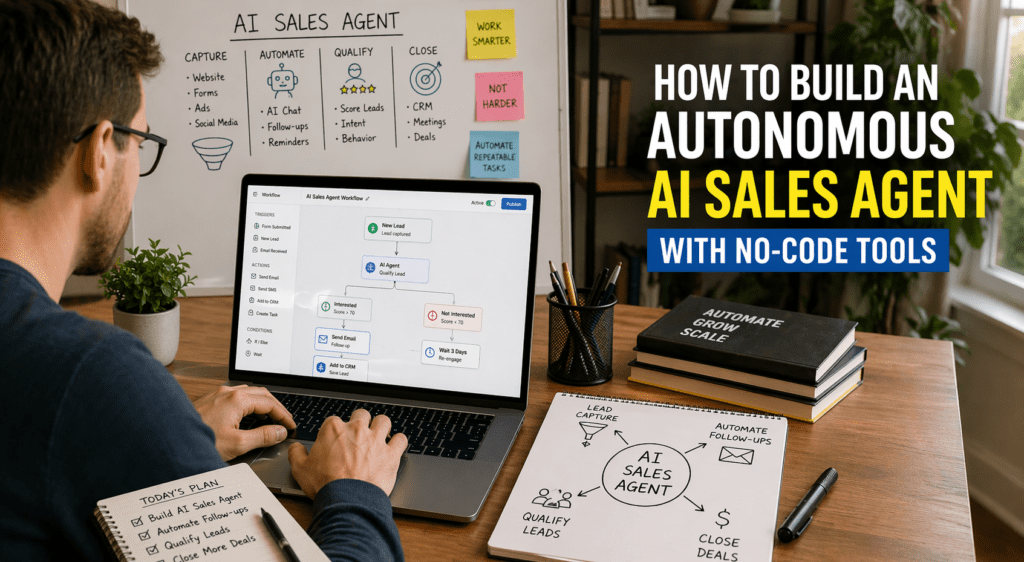
An autonomous AI sales agent is a system that can:
- Talk to leads automatically
- Answer product questions
- Qualify prospects
- Follow up at the right time
- Help close sales
It works 24/7 without manual input.
Unlike basic chatbots, these agents use multi-agent reasoning. That means different AI “roles” work together. One agent handles conversation. Another analyzes intent. A third decides the next action.
This creates a smarter, more human-like sales process.
Why Use No-Code AI Automation?
You don’t need coding skills anymore. That’s the biggest shift.
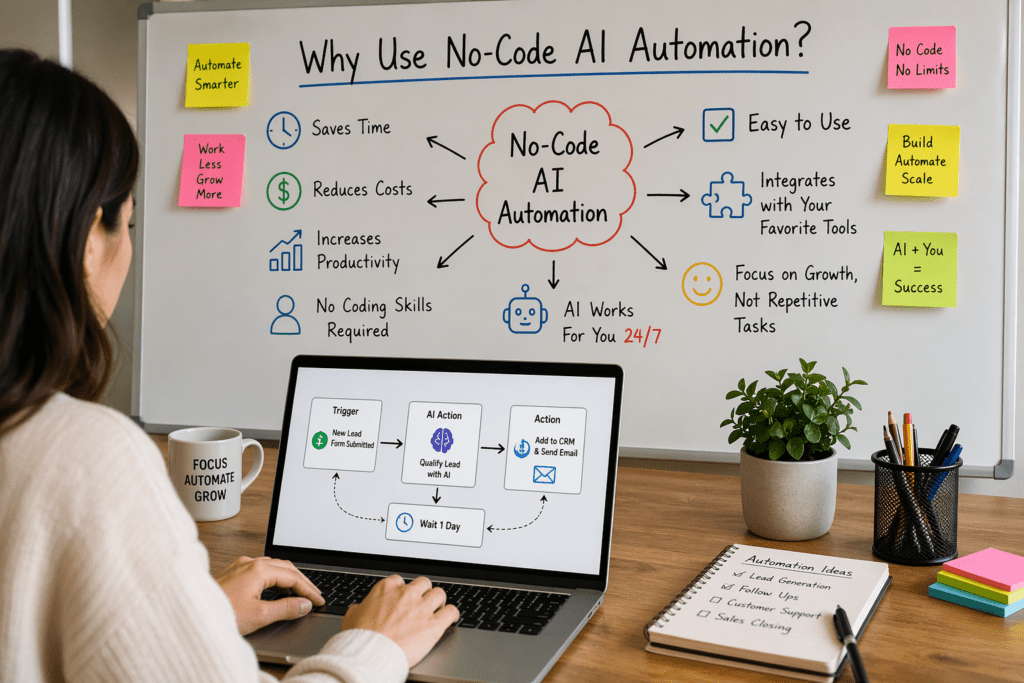
With no-code AI automation, you can build powerful workflows using drag-and-drop tools.
Benefits:
- Fast setup
- Low cost
- Easy to edit
- No developer needed
This makes it perfect for:
- Small businesses
- Freelancers
- Shopify store owners
- Digital product sellers
If you want to start an AI side hustle in 2026, this is a strong option.
Step 1: Define Your Sales Goal
Before using any tool, be clear about your goal.
Ask yourself:
- Do I want more leads?
- Do I want to automate follow-ups?
- Do I want to close sales automatically?
Example goals:
- Capture emails from website visitors
- Convert Instagram DMs into buyers
- Qualify leads before booking calls
Keep it simple. One clear goal works best.
Related: Here are 31 Best AI Video Generator Tools in 2026
Step 2: Choose Your No-Code AI Tools
You need a few tools to build your system. Most of them are beginner-friendly.
Core Tool Categories:
- Chatbot builder
- Automation platform
- AI text generator
- CRM or database
Popular no-code AI tools include:
- Chatbot builders for conversations
- Workflow tools for automation
- AI writing tools for responses
You don’t need all tools at once. Start small.
Step 3: Design Your Sales Workflow
Now comes the important part.
Your AI workflow should follow a simple journey:
- User visits your site or page
- AI starts conversation
- AI asks questions
- AI qualifies the lead
- AI suggests product or service
- AI follows up
This is the base of AI sales automation.
Keep your flow natural. Avoid robotic replies.
Step 4: Create Your AI Sales Agent
Now you build your agent.
Key Components:
1. Conversation Agent
This is the main chatbot. It talks to users.
It should:
- Greet users
- Ask simple questions
- Understand intent
2. Qualification Agent
This checks if the lead is a good fit.
Example:
- Budget
- Need
- Timeline
3. Decision Agent
This uses multi-agent reasoning.
It decides:
- Show product
- Offer discount
- Book call
Each agent works together behind the scenes.
Related: Here are 10 New AI Tools Nobody Knows About in 2026
Step 5: Train Your AI with Real Data
Your AI is only as good as your data.
Feed it:
- Product details
- FAQs
- Customer objections
- Sales scripts
Use simple language. Avoid complex terms.
Example:
Instead of “Our solution offers scalable integration,”
say “This tool helps you save time and grow faster.”
This makes your autonomous agents more human.
Step 6: Set Up Automation Triggers
Automation is where the magic happens.
You can trigger actions based on user behavior.
Examples:
- User leaves cart → send follow-up message
- User clicks link → send offer
- User inactive → send reminder
This is core no-code AI automation.
It helps you stay consistent without effort.
Step 7: Add Follow-Up Sequences
Most sales happen after follow-ups.
Your AI agent should:
- Send reminders
- Share testimonials
- Offer limited-time deals
Keep messages short.
Example:
“Still thinking about it? I can help you decide.”
This improves conversions.
Related: Here are 10 Proven Ways to Make Money with Canva in 2026 –$500+ Monthly
Step 8: Connect to Your Sales Channels
Your AI agent should work across platforms.
Common channels:
- Website chat
- Instagram DMs
This creates a smooth experience.
Your AI automation business ideas can expand from here.
Step 9: Test and Improve
Don’t expect perfection on day one.
Test your system:
- Ask questions like a customer
- Check responses
- Fix weak replies
Look at:
- Response accuracy
- Conversion rate
- Drop-off points
Improve step by step.
Step 10: Scale Your AI Sales System
Once it works, scale it.
You can:
- Add more products
- Create new workflows
- Build more agents
This is how people build passive income with AI.
Your system runs even when you sleep.
Related: Here are 15 Unique Side Hustles that Pay You Daily (Start Earning Today)
Best Practices for Success
To rank higher and perform better, follow these tips:
Keep It Simple
Avoid complex flows. Simple systems convert better.
Use Natural Language
Write like a human. Not like a robot.
Focus on Value
Help users. Don’t just sell.
Personalize Messages
Use names and preferences when possible.
Track Results
Measure what works. Improve what doesn’t.
Common Mistakes to Avoid

Many beginners make these mistakes:
- Overcomplicating workflows
- Using generic AI responses
- Not testing the system
- Ignoring follow-ups
- Not updating data
Avoid these, and your AI workflows for beginners will perform much better.
Real Use Cases
Here’s how people use autonomous AI sales agents:
1. E-commerce Stores
Answer product questions and recover abandoned carts.
2. Freelancers
Qualify leads and book calls automatically.
3. Coaches & Consultants
Sell courses and services through chat.
4. Agencies
Offer AI automation services to clients.
This is why automation side hustles are growing fast.
Future of AI Sales Automation

The future is moving toward smarter systems.
Soon, autonomous agents will:
- Understand emotions better
- Handle complex sales
- Work across multiple platforms
With multi-agent reasoning, systems will act more like real teams.
This is just the beginning.
Real Success Stories of Autonomous AI Sales Agents
The best way to understand the power of autonomous AI sales agents with no-code tools is to look at real-world results. Many businesses, from solo founders to large companies, are already using no-code AI automation to increase sales and save time.
Here are some proven examples.
1. From Manual Sales to $500K in 30 Days
Case Study: One fast-growing company replaced part of its sales team with an autonomous AI sales agent. This AI system handled outreach, replies, and follow-ups automatically.
Within just 30 days, the AI helped generate over $500,000 in revenue.
Instead of hiring more sales reps, the company used multi-agent reasoning. One agent managed conversations. Another qualified leads. A third decided the next step.
This case shows how AI sales automation can scale faster than traditional methods.
2. Small SaaS Startup Boosted Leads by 214%
Case Study: A small SaaS business struggled with low-quality leads. Their team wasted hours talking to people who never converted.
They implemented a no-code AI automation system to qualify leads before human interaction.
The results were impressive:
- 214% increase in qualified leads
- 70% less time wasted
- Nearly $500K in extra revenue
This is a perfect example of how autonomous agents improve efficiency and focus.
3. E-commerce Brand Reduced Costs by 40%
Case Study: An online store used an AI sales agent to recover abandoned carts and answer customer questions.
Instead of sending generic emails, the AI had real-time conversations with shoppers.
The outcome:
- 40% lower customer acquisition cost
- Higher conversions
- Better customer experience
This proves that no-code AI automation works very well for e-commerce businesses.
4. AI Saved $1.6 Million in Sales Costs
Case Study: A large company replaced many manual sales development tasks with AI agents.
The system automated outreach, follow-ups, and scheduling.
Results included:
- $1.6 million saved in salaries
- 256% increase in outreach capacity
- 75% higher response rates
Even at scale, autonomous AI sales agents deliver strong ROI.
What These Success Stories Teach Us
All these examples follow the same pattern.
Businesses that use autonomous agents:
- Respond faster
- Never miss leads
- Automate repetitive work
- Scale without hiring
The combination of:
- Autonomous AI sales agents
- No-code automation tools
- Multi-agent reasoning
creates systems that run 24/7.
Final Insight
These are not future ideas. They are working systems right now.
If small businesses and solo founders can achieve these results, you can too.
Start with a simple workflow. Use no-code AI automation tools. Improve step by step.
Over time, your AI sales agent can become your most valuable digital employee.
Related: Here are 6 Proven Ways to Make Money While You Sleep in 2026
Frequently Asked Questions (FAQs)
1. What is an autonomous AI sales agent?
An autonomous AI sales agent is a system that handles sales tasks automatically. It can chat with leads, answer questions, qualify prospects, and follow up without human help. These agents work 24/7 and improve over time using data.
2. Can I build an autonomous AI sales agent without coding?
Yes, you can build an autonomous AI sales agent with no-code tools. Platforms with drag-and-drop features make it easy. You don’t need programming skills. Many beginners use no-code AI automation to create working systems in a few hours.
3. What are the best no-code AI tools for sales automation?
Some popular tools include chatbot builders, workflow automation platforms, and AI writing tools. These tools help you create AI sales automation workflows without coding. The best choice depends on your business needs and budget.
4. How does multi-agent reasoning work in AI sales systems?
Multi-agent reasoning means multiple AI agents work together. One agent handles conversation, another qualifies leads, and another decides the next step. This makes the system smarter and more effective than a basic chatbot.
5. Is AI sales automation suitable for small businesses?
Yes, AI sales automation is perfect for small businesses. It saves time, reduces costs, and helps you scale faster. Even solo founders can use autonomous agents to manage leads and increase sales.
6. How much does it cost to build an AI sales agent?
The cost depends on the tools you use. Many no-code AI automation tools offer free or low-cost plans. You can start with a small budget and scale as your business grows.
7. Can AI agents really increase sales?
Yes, many businesses report higher conversions using autonomous AI sales agents. They respond instantly, follow up consistently, and never miss leads. This leads to better customer engagement and more sales.
8. What are the main benefits of using autonomous agents in sales?
The main benefits include:
- 24/7 availability
- Faster response times
- Automated follow-ups
- Better lead qualification
- Increased efficiency
These benefits make AI workflows for beginners very powerful.
9. Are autonomous AI agents difficult to manage?
No, most no-code AI automation systems are easy to manage. You can update responses, change workflows, and improve performance without technical skills.
10. What is the future of AI sales agents?
The future of autonomous AI sales agents looks strong. With better multi-agent reasoning, these systems will become more human-like. They will handle complex sales and work across multiple platforms.
Related: Here are 20 Top Secret Websites To Make Money : Up to $5000/mo